
Berlin Berlinale Guide 2026
Last Updated on April 3, 2026
The Berlin International Film Festival, affectionately known as the Berlinale, is one of the world’s most prestigious film festivals and a highlight of Berlin’s cultural calendar.
Held annually in February, this cinematic celebration transforms the German capital into a global hub for film lovers, industry professionals, and celebrities. Whether you’re a first-time attendee or a seasoned festival-goer, this guide will help you make the most of your Berlinale experience.
What is the Berlinale?
Founded in 1951, the Berlinale is one of the three biggest film festivals in the world, along with Cannes and Venice. Every year, it screens over 400 films across various sections, attracting around 300,000 attendees and 20,000 industry professionals.
But what makes the Berlinale different is the focus on the audience. You can attend about 90% of the events with a normal ticket, which reflects Berlin’s famously no-VIP culture. (Both Venice and Cannes focus more on industry professionals.) The Berlinale sells more tickets to the general public than any other major film festival.
The festival is known for its commitment to political cinema, emerging talents, and its uniquely public character.
The festival’s top prize, the Golden Bear (Goldener Bär), is one of cinema’s most coveted awards, while Silver Bears recognize excellence in directing, acting, and other categories.
Berlinale: When and Where
In 2026, the Berlin Berlinale runs from February 12-22, 2026. It always runs for 10-11 days in mid-to-late February.
Berlin is always a hotspot for tourists, but this is one of the busiest times of year—yes, even despite the winter weather! For just shy of two weeks, the city lights up all over again, as the city welcomes a diverse array of movie stars, filmmakers, and fans.
The heart of the Berlinale beats at Potsdamer Platz, with additional venues around the city. Historically, Potsdamer Platz was the no-man’s-land around the Berlin Wall, but today it’s home to Berlin’s few skyscrapers.
The Berlinale main venues include:
Berlinale Palast
- Marlene-Dietrich-Platz 1, 10785 Mitte | Map
- The festival’s main venue for premieres and gala screenings
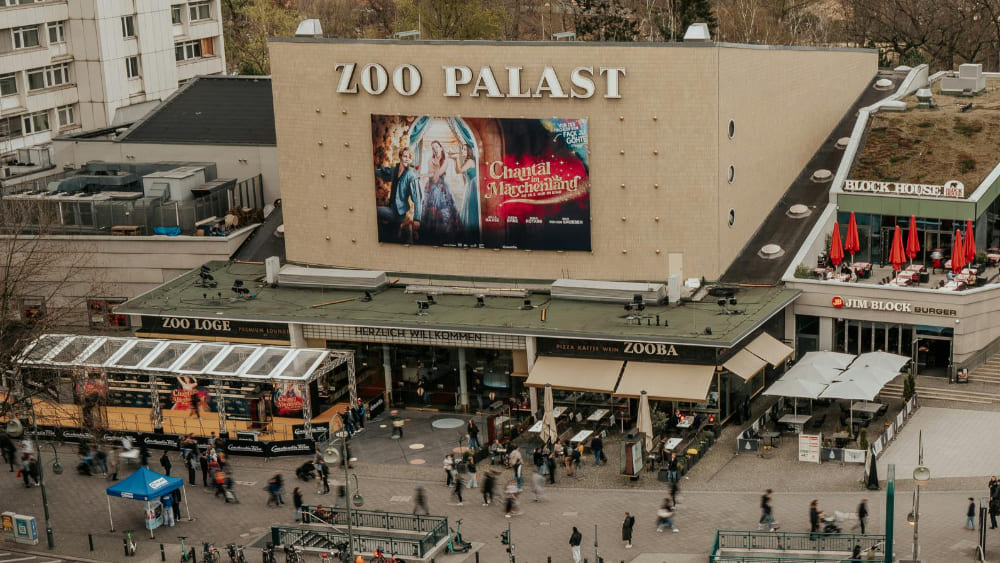
Zoo Palast
- Hardenbergstraße 29A, 10623 Charlottenburg | Map
- A beautiful and historic cinema on Kurfürstendamm. (It was the first venue of the Berlinale in 1951.)
CinemaxX Potsdamer Platz
- Potsdamer Str. 5, 10785 Mitte | Map
- A multiplex cinema hosting numerous screenings
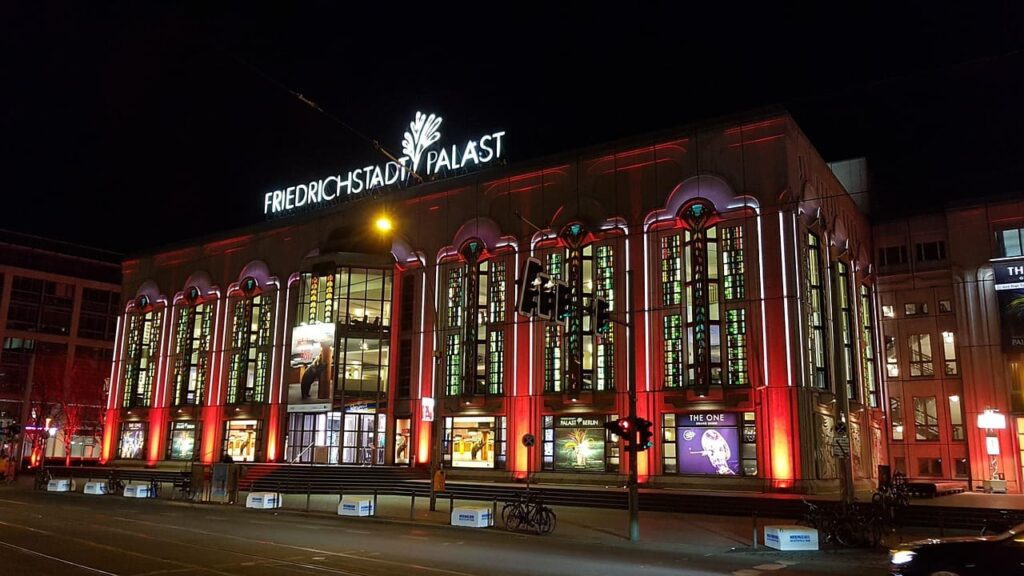
Friedrichstadt Palast
- Friedrichstraße 107, 10117 Mitte | Map
- A large and historic venue typically known for its Vegas-style shows
Various other cinemas
- across Berlin
How To Buy Tickets to The Berlinale
TIckets are available on the Berlinale website here. Just be warned that they sell out quickly!
Berlinale tickets go on sale a few weeks before the festival. There are a few different ticket types:
- Individual tickets for single screenings (Typically around €15-20)
- Day passes for unlimited films on a specific day
- Festival passes for access throughout the festival
- 6-ticket packages offering flexibility at a discount
Buying Berlinale Tickets Online Tips
Tickets go on sale in stages. You’ll need luck and a solid strategy to snag your seats.
Here’s a basic Berlinale ticket-buying game plan:
Online sales typically begin a week before the festival starts, with high-demand films selling out within minutes. So start doing your preparation well before the tickets go on sale.
To buy tickets, create an account on the Berlinale website ahead of time. (As of 2020, there is no longer a Berlinale app.)
Make a note of all the films you want to watch. In general, you should have multiple film choices ready, and consider less hyped sections like Panorama or Generation for hidden gems with better availability.
On the day of the ticket release, log into your account around 9:45 am. (This is usually three days before the screening but sometimes they appear even earlier.) This will add you to the virtual queue. Being even 15 minutes late to this will likely yield disappointment!
Then start refreshing the page around 9:59, until you manage to get through.
Some same-day tickets are also released each morning at 10 am.
After you reserve your tickets, you will be redirected to the Eventim website to enter your payment details. Your tickets will be reserved for 15 minutes, so if you get tempted to go back for more, just be sure to keep an eye on the time. (FYI, there are no processing fees.)
After you’ve completed the transaction, you’ll have two options: print your tickets at home (lol as if) or save them to your phone. Your tickets are easily saved to your Apple or Google wallet.
Now, if you succeed in buying the ticket(s), you have two options: print them at home or save them as a mobile pass. Save the tickets on your Apple or Google Wallet and go straight to the venue.
Buying Berlinale Tickets in Person
Unlike previous years, tickets are no longer available from the box office. It’s online only.
Is there something you really want to see that is sold out? Sometimes, you can luck out and find them on eBay Kleinanzeigen or other online outlets for considerably more than the original price. (Please exercise caution if you try this route!)
Berlinale Festival Sections
With so many movies, organization is essential. To that end, the Berlinale is divided into several sections, each with its own character:
Competition
The Competition films are typically the most prestigious films of the Berlinale and usually the world premieres. They are international films competing for the Golden and Silver Bears. If you’ve ever seen famous directors or actors on the red carpet at the Berlinale, it was likely in support of a Competition film. As such, these selections also draw big crowds of fans outside, with people looking for a glimpse of their favorite actors. (Perhaps even Timothee Chalamet, wearing pink again!)
Here’s the Competition programing for 2026.
Berlinale Special
The Berlinale Special includes high-profile films outside the competition. These also frequently have star-studded premieres. They also host both new and old movies in this section, so at times it’s possible to watch an old favorite in a modern cinema.
Panorama
The Panorama section focuses on arthouse and independent films. It’s where established but not yet famous directors tend to present their films. This is a great pick for interesting stories and beautiful cinematography. If you’re not sure what to see, choosing something from the Panorama section is generally a great bet.
Here’s the Panorama programming for 2026.
Forum
The Forum section focuses on experimental and avant-garde films challenging conventional filmmaking. Hands down, this is the arthouse of the Festival, making it perfect for those who appreciate more experimental works or an unusual aesthetic. This is a great section if you’re into more artistic or underground film. But if you’re more of a blockbuster movie type, it’s probably better to skip it.
Generation
The Generation section is aimed at young audiences, divided into Kplus (ages 4+) and 14plus sections. Don’t let the suggested ages push you away. These are often enjoyable, even for the adults!
Berlinale Goes Kiez
The Berlinale Goes Kiez offers a way for the Berlinale to extend its reach beyond Potsdamer Platz. Every year, select smaller cinemas present Berlinale movies. How charming: a local audience and a neighborhood (kiez) feeling combined with cutting-edge Berlinale picks.
Berlinale Shorts
The Shorts section is focused on short movies. That means anything from one to thirty minutes. Interesting yes, but be sure it’s worth the effort of the ticket buying process as well as getting to the venue.
Film Selection Strategy Tip
Mix Competition films with discoveries from Panorama and Forum. Don’t miss the Retrospective if the theme interests you. Generation films are often surprisingly sophisticated and overlooked by adult audiences.
Our Berlinale 2026 Picks
- “The Moment” mockumentary featuring Charli xcx, Alexander Skarsgård, Rosanna Arquette, Hailey Benton Gates, Jamie Demetriou (& Kylie Jenner)
- “At The Sea” with Amy Adams, Murray Bartlett, Chloe East, Brett Goldstein and Dan Levy
- “Yön Lapsi” with Seidi Haarla and Rupert Grint
- “Rosebush Pruning” with Callum Turner, Riley Keough, Jamie Bell, Elle Fanning, and Pamela Anderson
- “Queen at Sea” with Juliette Binoche, Tom Courtenay, Anna Calder-Marshall, and Florence Hunt
- “The Weight” with Ethan Hawke, Russell Crowe, Julia Jones, Austin Amelio, and Avi Nash
- “Die Blutgräfin/The Blood Countess” with Isabelle Huppert, Birgit Minichmayr, Thomas Schubert, Lars Eidinger, and André Jung
Going To The Berlinale
When To Get There?
Congrats! You’ve successfully secured your ticket, and you’re ready to go to the film. It’s important to know that seats are not allocated at the time of purchase. That means that it’s important to get to the cinema early in order to secure a good seat.
The question is: how early do I need to be there? Usually, the cinema doesn’t open until about 15 minutes before the screening. So I suggest getting there at least 20 minutes early, in order to be early in the queue and secure a good seat.
If you arrive on time or even 10 minutes ahead of time, expect that you will be sitting in the front row or that you won’t be able to sit next to your friend/partner etc.
Late admittance is prohibited! So if you’re late, you won’t get in at all.
Subtitles
Wondering what language you will be watching? If you’re English-speaking, this can be a tricky thing in the normal German cinemas
Rest assured, every non-English Berlinale movie comes with English subtitles. This is an international film festival, and many international visitors are not German-speaking.
Likewise, if you prefer to read in German, the English-speaking movies will have German subtitles.
Beyond the Screenings
The Berlinale experience extends far beyond cinema seats. Here are some more Berlinale options.
The Berlinale Red Carpet
Want to see a celebrity? Or maybe you want to be part of the movie magic without a movie ticket. Fans can head to the public viewing areas in order to make their movie dreams come true. (Just be warned that they fill up quickly!)
It’s loud and filled with people crying and asking for autographs—definitely not for everyone, but it’s an experience. But if you’re up for the challenge, be sure to arrive armed with your own pen and paper.
For the biggest names, fans will start arriving several hours before showtime.
These Red Carpet sessions are usually at the Berlinale Palast, Zoo Palast, and Friedrichstadtpalast. The Red Carpet schedule is typically announced a day or two beforehand. So keep checking back if you want to be a part of it!
Screening Q&As
Most premieres include a Q&A afterward, which is a great way to learn more about the film, directors or actors.
The schedule will tell you if there’s one happening at your screening, and you are welcome to stay after the film and listen in. These are well-worth sticking around for. The insights can be fascinating! Also, don’t be shy. Raise your hand and ask a question if you’re inspired to.
Can I go to the Berlinale parties?
Parties go hand-in-hand with the Berlinale, and there are a wide range of official and unofficial parties to choose from. However, getting into these parties is usually a challenge, especially the official parties. These are usually attended by the Berlinale participants as well as prominent Berliners. If you can manage to snag a ticket, they’re worth checking out.
Some non-official parties will be happening too, and those are typically easier to go to. Keep an eye on social media and the news, and hopefully you’ll track down an invitation or two.

Planning Your Berlin Berlinale Experience
Where To Stay For The Berlinale
Booking your accommodation during the festival is another tricky task. My best advice is to book your accommodation early. During February, hotel prices will always spike but booking ahead can help.
If you’re visiting Berlin, there are several hotels near Potsdamer Platz that will be perfect for your stay.
- Grand Hyatt Berlin | Marlene-Dietrich-Platz 2, 10785 Tiergarten | Map
- The Mandala | Potsdamer Str. 3, 10785 Tiergarten | Map
- The Ritz-Carlton Berlin | Potsdamer Platz 3, 10785 Tiergarten | Map
- Scandic Berlin Potsdamer Platz | Gabriele-Tergit-Promenade 19, 10963 Tiergarten | Map
- Grimm’s Hotel am Potsdamer Platz | Flottwellstraße 45, 10785 Tiergarten | Map
- Motel One Potsdamer Platz | Leipziger Str. 132, 10117 Mitte | Map
These hotels tend to fill up quickly, and the whole area is quite crowded during the festival. So you might want to book something further away. A good option is Charlottenburg near the Zoo Palast. It has a few venues of its own and it’s well-connected to Potsdamer Str by public transport. (It’s about 20 minutes by bus.)
Here are a few options:
- Waldorf Astoria Berlin | Hardenbergstraße 28, 10623 Charlottenburg | Map
- Motel One Berlin Upper West | Kantstraße 163-165, 10623 Charlottenburg | Map
- 25hours Bikini Berlin | Budapester Str. 40, 10787 Charlottenburg | Map
- Hollywood Media Hotel Berlin | Kurfürstendamm 202, 10719 Charlottenburg | Map
- Park Plaza Berlin | Lietzenburger Str. 85, 10719 Charlottenburg | Map
Budget-wise, the Motel Ones are the most affordable hotels on this list. But of course, if you have a transit pass, you can also stay farther afield.
How to Get Around at the Berlinale
Unless you’re staying at Potsdamer Platz and only seeing films there, you’ll likely want to invest in a public transportation pass.
The public transportation in Berlin is reliable and easy to use. In 2026, a single one-way ticket costs €4. You can save money by purchasing a pack of 4 tickets or by buying a pass for a few days (or a week).
The easiest way to do that is through the BVG app, although you can also pay with cash or card at the machines at the stations.
Get the BVG Fahrinfo app here.
If you’re visiting Berlin, you might want to consider the Berlin Welcome Card. This card comes with three tiers: Classic, Museum Island, and All-Inclusive. It includes your public transportation as well as discounts or free entry to some attractions.
You can get your Berlin Welcome Card here.

Get Your Berlin Welcome Card!
This special tourist ticket gets you both city public transit access plus big discounts to Berlin’s top attractions. Click here!
Eating At The Berlinale
If you’re hungry, there are typically a few snack options available at the cinemas. (And also because it’s Europe: beer and wine!) But in general, you might have to plan well, in order to eat if you’re running around to a lot of films.
Here are some quick fast-food-type options around Potsdamer Platz:
- Mall of Berlin food court | Leipziger Pl. 12, 10117 Mitte | Map
- Kerb Food Hall | Potsdamer Str. 2, 10785 Tiergarten | Map
- Manifesto Market | Alte Potsdamer Str. 7, 10785 Tiergarten | Map
- Viet Bowl | Marlene-Dietrich-Platz 1, 10785 Tiergarten | Map
For more inspiration, check out our list of the coolest restaurants in Berlin or the best German food in Berlin.
Making the Most of Berlin
Berlin is a vibrant city with a lot to offer. While the festival might be your main focus, don’t miss out on Berlin itself:
- Explore the city’s incredible museum scene, especially around Museum Island. Check out our museum guide here.
- Visit historical sites like the Brandenburg Gate and East Side Gallery. Check out our full Berlin travel guide here.
- Experience Berlin’s legendary nightlife.
- Enjoy the city’s diverse culinary scene, from Turkish markets to Michelin-starred restaurants. Check out our guide to the coolest restaurants in Berlin here or the best German food here.
- Discover Berlin’s unique neighborhoods like Kreuzberg, Neukölln, and Prenzlauer Berg
Berlinale FAQ
When is the Berlinale program published?
The full Berlinale program is published in early February, not long before the opening.
But go ahead and create your account on the Berlinale website ASAP. It’s smart to start browsing and making notes ahead of time, because there are a lot of movies to choose from.
What’s the weather like for the Berlinale?
February in Berlin is cold (around 0-5°C). Layer up! Prepare for cold weather, and even snow, with warm, comfortable clothing and good walking shoes
What are The Berlinale Awards?
The Berlinale is centered around the Berlinale awards, which include the Golden and Silver Bears. (The bear is the official city animal of Berlin.)
Every year, the international jury is selected by the Festival Director and gives out several awards:
- Golden Bear for Best Film
- Silver Bear Grand Jury Prize
- Special: Silver Bear Alfred Bauer Prize for a feature film that opens new perspectives.*
- The Silver Bear for Best Director
- Silver Bear for Best Actress
- Silver Bear for Best Actor
- The Silver Bear for Best Screenplay
- Silver Bear for Outstanding Artistic Contribution in the categories of camera, editing, music score, costume, or set design.
- Sometimes there is also an Honorary Golden Bear award, like this year with it going to Michelle Yeoh.
Where can I get Berlinale updates?
The best way to get updates is to keep an eye on the Berlinale news channel here.
Now Sit Back and Enjoy The Movie!
The Berlinale is a true celebration of cinema’s power to challenge, inspire, and unite. The festival’s democratic spirit, combined with Berlin’s creative energy and turbulent history, creates an atmosphere unlike any other major festival. Whether you’re catching the next Palme d’Or winner in Competition or discovering an unknown gem in Forum, the Berlinale offers an unforgettable journey through world cinema.
Pack your warmest coat, secure your tickets, and prepare for 10 days of cinematic immersion. See you at the Berlinale!


Coming to Berlin?
Read This Next:
- Where to get the best pizza in Berlin
- Where to get the best tacos in Berlin
- Best Ukrainian restaurants in Berlin
Love This Post? Then Pin It!